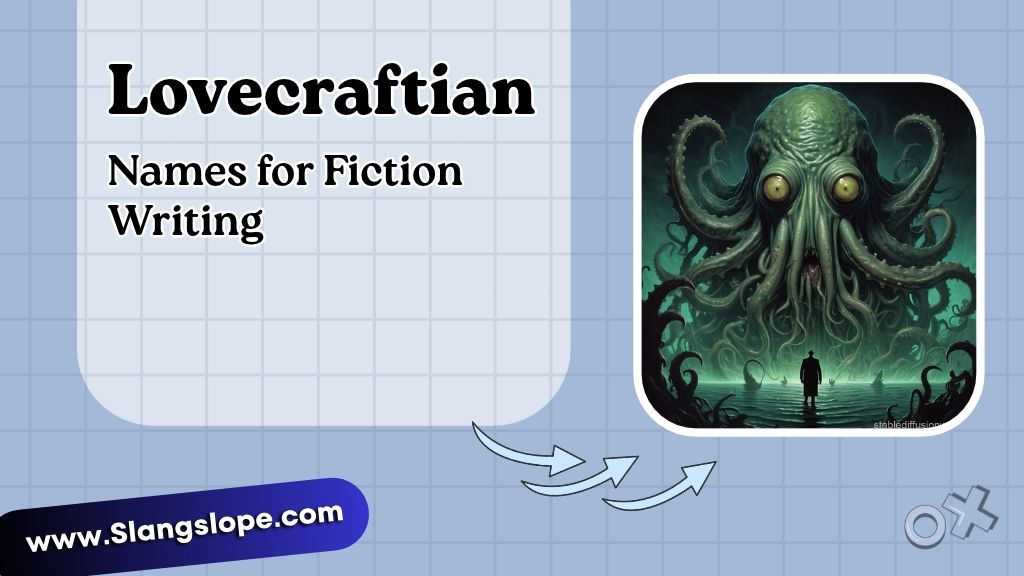
Lovecraftian names carry a specific sound guttural, ancient, and slightly wrong in the best possible way. Here’s every category you need.
The Classic Cosmic Pantheon Names
Names pulled from H.P. Lovecraft’s original mythos — these carry the heaviest lore weight.
| Name | Meaning / Origin | Best For |
| Cthulhu | Invented by Lovecraft; phonetically suggests “call” in R’lyehian | Main villain characters, boss-tier NPCs |
| Nyarlathotep | “Crawling chaos” — Egyptian-styled syllables blended with invented sounds | Shapeshifter characters, trickster antagonists |
| Azathoth | “Blind idiot god” — Arabic root aza (power) + invented suffix | Ultimate villain, world-ending entities |
| Shub-Niggurath | “Black goat of the woods” — Semitic-sounding invention | Nature-horror entities, dark deity names |
| Yog-Sothoth | Gatekeeper of all time and space — pure Lovecraft invention | Cosmic oracle characters, time-magic villains |
| Dagon | Taken from real Philistine/Babylonian fish deity | Sea-horror characters, cult leader names |
| Hastur | Originally from Ambrose Bierce; expanded by Lovecraft | Forbidden god characters, unspeakable beings |
| Nodens | From real Celtic deity of hunting and healing, reimagined | Anti-hero elder gods, morally grey entities |
Eldritch Character Names for Fiction Writing
Male-Coded Lovecraftian Names
| Name | Meaning / Origin | Best For |
| Ardathan | Invented; hard consonants suggest age and authority | Cult leader, dark scholar |
| Vorthex | “Vortex” twisted — implies spiral, chaos | Chaos mage, void-touched warrior |
| Zelmoor | Invented; moor grounds it in bleak landscape imagery | Wandering prophet, cursed traveler |
| Ithaqar | Blends Ithaqua (wind-walker god) with Semitic -ar suffix | Arctic horror character, wind elemental |
| Drekuln | Slavic drek (filth) + runic suffix | Swamp horror, decaying undead |
| Morbaeus | Latin morbus (disease) + Greek -aeus | Plague bringer, cursed physician |
| Qaelthor | Invented; the Q without u signals alien phonology | Non-human scholar, dimensional traveler |
| Vrethis | Invented; sibilant ending creates unease | Shadow assassin, whisper-based entity |
| Unglath | Harsh guttural stop — sounds like something that shouldn’t be said aloud | True name of a demon, forbidden knowledge keeper |
| Setharak | Egyptian Seth (chaos god) + -arak suffix | Desert-dwelling horror, chaos priest |
Female-Coded Lovecraftian Names
| Name | Meaning / Origin | Best For |
| Lyriath | Invented; soft opening with hard ending creates dissonance | Siren-type entity, deep sea horror |
| Selvara | Invented; sylva (forest) corrupted — nature gone wrong | Forest horror, feral witch |
| Thessivane | Blends Thessaly (Greek region of magic) + -vane | Prophetic character, mad oracle |
| Uladreth | Invented; the Ul- prefix sounds primordial | Ancient being wearing human form |
| Vexorath | Vex (to trouble) + invented suffix | Tormentor entity, nightmare weaver |
| Crimthane | Old Irish crimson + invented ending | Blood-magic character, dark priestess |
| Morthalis | Latin mors (death) + Greek suffix | Death goddess figure, necromancer |
| Yssabel | “Isabel” deliberately corrupted — familiar name made uncanny | Human-turned-monster, identity-horror character |
| Zoveth | Invented; short and percussive — hard to forget | Cult matriarch, mind-reader villain |
| Nalathra | Invented; flowing syllables that feel wrong the longer you say them | Shapeshifter, entity that mimics humans |
Gender-Neutral Lovecraftian Names
| Name | Meaning / Origin | Best For |
| Aelthar | Invented; ael suggests elvish but the -thar corrupts it | Ageless wanderer, forgotten god |
| Vreth | One syllable — ancient languages often strip names down | True name, cursed sigil |
| Xolund | Invented; X-opening creates instant alien quality | Beyond-dimension entity |
| Osrath | Old English os (god) + invented suffix | Demigod character, fallen divine |
| Thessun | Invented; sounds like “lesson” filtered through static | Scholar of forbidden texts |
| Umvael | Invented; the Um- prefix sounds like the universe clearing its throat | Void entity, origin-of-all being |
| Krethis | Invented; Kre- sounds biological and wrong | Parasite entity, hive-mind fragment |
| Nylveth | Invented; Nyl- suggests nylon — modern material made ancient | Industrial horror, urban Lovecraft setting |
Lovecraftian Pet Names

Yes, people name their cats after cosmic horrors. Here’s how to do it properly.
For Cats
| Name | Why It Works | Personality Fit |
| Nyarla | Short form of Nyarlathotep — cats already act like shapeshifting chaos gods | Any cat with multiple personalities |
| Miskatonic | Named after Lovecraft’s fictional university — feels academic and ominous | Serious, judgy cats |
| Dagon | One syllable when called — “Dag!” — practical and dark | Large, slow-moving cats |
| Pickman | From Lovecraft’s story Pickman’s Model — artist who painted ghouls | Cats that stare at walls |
| Shubby | Endearing shortform of Shub-Niggurath | Fluffy black cats |
| Yog | Ultra-short, easy to call across a room | Cats that ignore you anyway |
| Asenath | From The Thing on the Doorstep — human name with horror backstory | Sweet-looking cats with unsettling eyes |
| Wilbur | From The Dunwich Horror — sounds normal, is very not | Large, unsettlingly intelligent cats |
For Dogs
| Name | Why It Works | Personality Fit |
| Hound | Direct reference to The Hound — Lovecraft story | Fast, obsessive breeds |
| Tindalos | From the Hounds of Tindalos — creatures from angular time | Dogs that get stuck in corners |
| Glaaki | From Ramsey Campbell’s mythos expansion — sounds like a bark | Deep-voiced large breeds |
| Zoth | Short, sharp — works as a command name | High-energy dogs that need firm calls |
| Barnabus | Used in Lovecraft’s correspondence — old-fashioned and eerie | Old English Sheepdogs, slow movers |
Lovecraftian Place Names (for Worldbuilding)

| Name | Suggested Geography | Atmosphere |
| Vrethmark | Coastal village | Fog-bound, fishing community with a secret |
| Ashenmoor | Inland swamp | Black water, dead trees, wrong bird sounds |
| Uldareth | Mountain pass | High altitude, thin air, geometric rock formations |
| Misport | Harbor town | Built on something older than the docks |
| Kethallow | Forest settlement | The trees grow toward the center of town, not up |
| Drelthaven | Underground city | No natural light source — something else glows |
| Ossuary Flats | Desert | Bones pre-date any known civilization |
| Vornbridge | River crossing | The bridge is always there regardless of which direction you approach |
Lovecraftian Cult & Organization Names
| Name | Type | Implied Purpose |
| The Amber Choir | Secret society | Communicate through resonant frequencies |
| The Hollow Covenant | Religious cult | Worship absence — what existed before matter |
| Order of the Drowned Threshold | Oceanic brotherhood | Guard something beneath the continental shelf |
| The Pale Ledger | Academic group | Document things that shouldn’t be documented |
| Children of the Outer Black | Generational cult | Bred across centuries for a single event |
| The Unwritten Congress | Political conspiracy | Operate between nations — no country claims them |
Lovecraftian Names from the Expanded Mythos
Other authors built on Lovecraft’s foundation. These names come from that wider tradition.
| Name | Source Author | Origin / Notes |
| Glaaki | Ramsey Campbell | Invented for The Inhabitant of the Lake |
| Eihort | Ramsey Campbell | Labyrinth god — bargains with humans |
| Byakhee | August Derleth | Interstellar creatures serving Hastur |
| Zhar | August Derleth | Twin entity to Lloigor |
| Lloigor | August Derleth | Vortex beings that feed on life energy |
| Thasaidon | Clark Ashton Smith | Lord of evil — dark underworld figure |
| Tsathoggua | Clark Ashton Smith | Toad-like hibernating god of formless spawn |
| Yidhra | Walter C. DeBill Jr. | Dream witch — predates all multicellular life |
| Mnomquah | Brian Lumley | Moon deity imprisoned in underground lake |
Editor’s Top Picks
Nyarlathotep — The single most usable Lovecraftian name in fiction. It has natural nickname potential (Nyarla, Hotep), phonetic rhythm that feels spoken rather than written, and enough mythos weight to satisfy hardcore fans without alienating newcomers.
Tsathoggua — Clark Ashton Smith’s contribution is criminally underused. Four syllables that somehow feel lazy and threatening simultaneously — perfect for any slow-moving, ancient evil that doesn’t need to rush.
Yssabel — The uncanny valley approach to naming works brilliantly here. It’s close enough to “Isabel” that readers recognize it, far enough that something feels off immediately. Best technique for human-adjacent horror characters.
Vreth — Single syllable names hit harder than multi-syllable ones in tense scenes. “Vreth spoke” reads faster than “Nyarlathotep spoke.” Keep this for written fiction where pacing matters.
Miskatonic — As a pet or ship or institution name, nothing lands harder. The fictional university is now more culturally embedded than most real universities in horror circles.
Qaelthar — The Q-without-U construction is one of the cleanest signals that a name belongs to no human language. Use it for entities that predate human phonology.
Thessivane — The dissonance between its soft opening and abrupt ending does psychological work before the character even appears on page. Strong choice for prophetic or oracle-type characters.
How to Build Your Own Lovecraftian Name
The phoneme toolkit:
Lovecraftian names use specific sounds repeatedly. Learn these patterns and you can generate unlimited names.
| Sound Type | Examples | Effect |
| Guttural stops | Kh-, -gh-, -th- | Ancient, physical discomfort when spoken |
| Sibilants | -ss-, -th, -sh | Whispering, serpentine, unsettling |
| Unpronounceable clusters | Cth-, Rly-, Yl- | Signals non-human origin immediately |
| Hard endings | -oth, -ath, -ek | Cuts off sharply — implies finality |
| Soft openings + hard endings | Ly-rath, Sel-vrek | Creates internal dissonance |
Syllable rules that actually work:
- 2-3 syllables for names used frequently in dialogue
- 4-5 syllables for names spoken rarely, ceremonially, or with dread
- 1 syllable for true names — the kind that cost something to speak
- Never end a Lovecraftian name in a happy vowel sound (-ee, -ay) unless you’re writing comedy
The corruption technique: Take a real name from history or mythology, find a parallel structure in a different language root, then blend them. Morbaeus = Latin disease root + Greek suffix. Setharak = Egyptian chaos god + invented extension. The hybrid feels both familiar and wrong — which is exactly the target.
Style Comparison: Quick Reference
| Style | Name Examples | Use When |
| Pure Lovecraft Invention | Azathoth, Yog-Sothoth | Maximum mythos authenticity |
| Corrupted Real Names | Dagon, Nodens, Yssabel | Uncanny valley effect |
| Extended Mythos | Tsathoggua, Glaaki | Wider horror fiction range |
| Original Eldritch | Vorthex, Zelmoor, Qaelthar | Original fiction, no canon conflicts |
| Short/True Names | Vreth, Zoth, Osrath | High-impact single-use moments |
| Place-as-Name | Miskatonic, Tindalos | Worldbuilding, pet names, bands |
Discover More Names Guide

Hi, I am Malaika and I studied MPhil English at The University of Faisalabad. Names have always fascinated me — especially the stories, cultural roots, and hidden meanings behind the labels we give to people, pets, places, and characters.
I write for Slangslope.com because naming isn’t just about picking words; it’s about finding the right identity. My work focuses on uncovering accurate origins, real-world usage, and creative naming ideas that fit actual context rather than generic lists.
My goal is simple: if you leave a page finding the perfect name or understanding its meaning better than before, then the article has done its job.